By Angel | Degusa Bags Team
Published: June 20, 2026
Updated: June 20, 2026
Many overseas buyers have had the same experience: they send one bag design to several suppliers, but the quotations come back very different. Sometimes the gap is small. Sometimes one supplier’s price may be much lower or much higher than the others.
This can be confusing, especially when the bag looks simple and the suppliers all say they can make it. Buyers may wonder whether one supplier is overcharging, or whether another supplier is cutting too many corners.
In most cases, the price difference does not come from one single reason. It usually comes from several cost factors together, including material quality, lining, zipper, hardware, logo method, packing, quality control, production loss and service support.
This article explains why different suppliers may quote different prices for the same bag, and why buyers should not compare quotations only by the lowest unit price.
Quick Answer: Why Can the Same Bag Have Very Different Prices?
The same bag can have very different quotations because suppliers may use different assumptions for material, lining, zipper, hardware, logo method, packing, quality control, production loss and project support. Even if the design looks similar, the actual production standard may not be the same.
For overseas buyers, the best way to compare quotations is not only to ask “Which price is lower?” but also “What exactly is included in this price?”
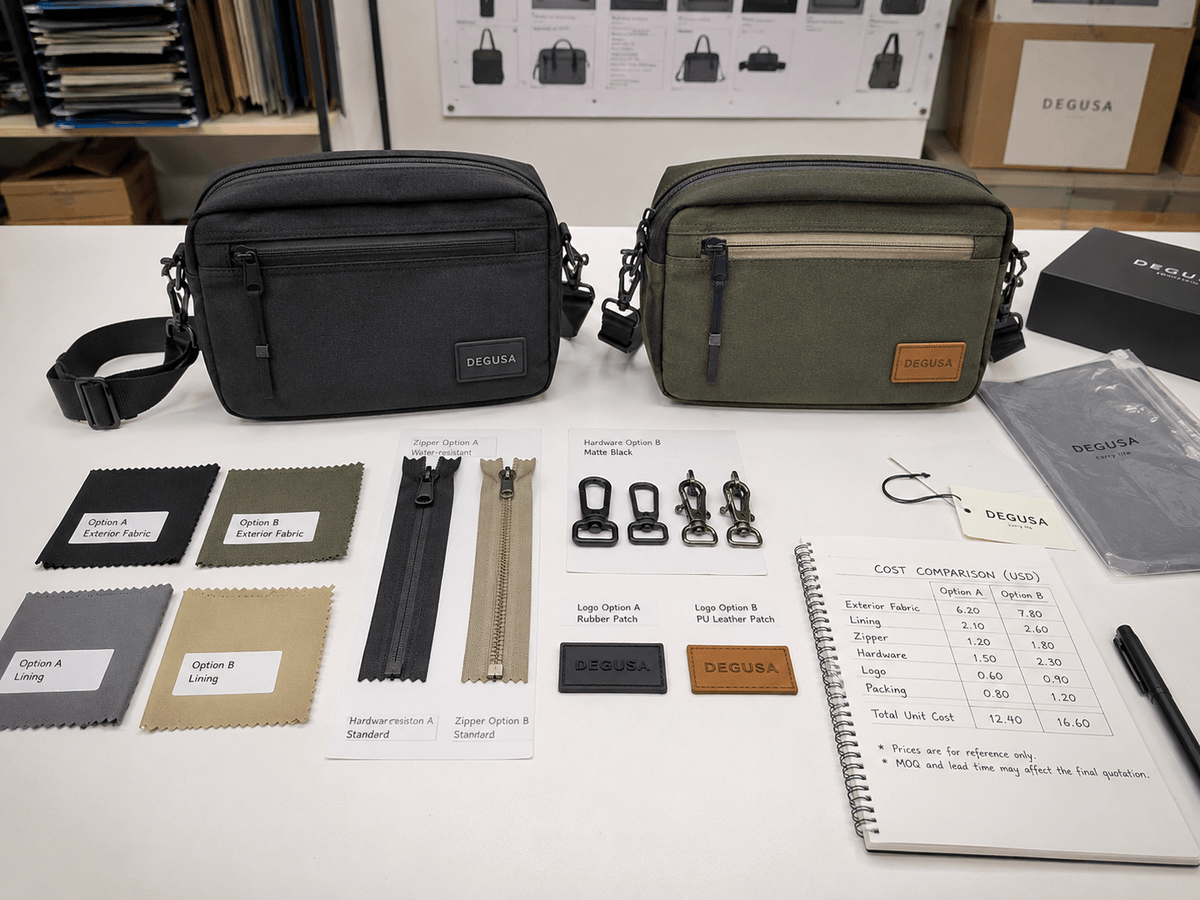
Material is one of the biggest reasons why prices differ. Two bags may look similar in photos, but the fabric quality may be very different.
For example, one supplier may quote based on thicker polyester, stronger oxford fabric or better water-resistant coating, while another supplier may use lighter or lower-cost material. Some materials may also have better color fastness, more stable texture or stronger durability.
Buyers should not only ask what the fabric name is. They should also ask about:
- Fabric type
- Fabric thickness
- Fabric weight
- Coating or backing
- Water resistance if needed
- Structure and hand feel
- Whether the fabric is standard stock or custom sourced
If the material standard is not the same, the quotation cannot be compared fairly.
2. Lining and Inner Construction Also Affect Cost
Some buyers focus mainly on the outer material, but the lining and inner construction also change the cost. One supplier may use a lighter lining, while another may use thicker lining, foam padding or additional support material.
This is especially important for products such as backpacks, cooler bags, laptop bags and structured travel bags. A stronger inside construction usually improves the user experience, but it also increases material and labor cost.
Differences may include:
- Lining quality
- Foam or padding thickness
- Reinforcement board
- Pocket construction
- Divider or compartment design
- Additional support structure
When a buyer receives different prices, it is useful to check whether the suppliers are quoting the same inner construction.
3. Zippers and Hardware Can Change the Price More Than Buyers Expect
Zippers and hardware often look like small details, but they can have a clear cost impact. A smooth and reliable zipper costs more than a basic zipper. Metal hardware may cost more than plastic hardware. Branded pullers or custom pullers also add cost.
Common price differences come from:
- Zipper brand or quality level
- Zipper size
- Metal or plastic pullers
- Buckles and D-rings
- Hooks, sliders and adjusters
- Custom hardware finish
- Logo on zipper pullers
If one supplier quotes with standard hardware and another quotes with better or customized hardware, the bag price will not be the same.
4. Logo Method Makes a Real Difference
Logo cost is another major reason for quotation differences. Buyers sometimes send one logo file and assume every supplier will quote it the same way. In reality, different suppliers may choose different logo methods unless the buyer specifies it clearly.
For example, a screen print logo, embroidery logo, woven label, rubber patch, leather patch or metal logo plate all have different costs.
ven within the same logo method, the cost may vary because of:
- Logo size
- Number of logo colors
- Stitch count for embroidery
- Mold cost for rubber patch or metal logo
- Position of the logo
- Whether the logo is sewn before or after assembly
If the buyer does not clearly confirm the logo method, one supplier may quote a simpler option and another may quote a higher standard option.
5. Packing Is Often Included Differently
Some suppliers quote only the product itself. Others include polybag, hangtag, barcode label, carton mark, stronger export carton or other packing details.
This is why two quotations may look very different even if the bag body cost is similar.
Packing cost can be affected by:
- Individual polybag
- Printed hangtag
- Barcode labels
- Warning labels
- Tissue paper or stuffing
- Special folding method
- Carton quality
- Carton size limitation
- Pallet requirement if needed
For overseas buyers, this is important because a lower quotation may not include the final packing standard needed for shipment or retail use.
6. Quality Control and Inspection Standard Are Not Always the Same
A lower price may sometimes mean a lighter quality control process. A supplier with a better inspection process may spend more time checking material, stitching, logo position, packing and carton marks before shipment.
This does not always appear clearly in the quotation, but it affects the real order value.
Some suppliers may include:
- Material checking
- In-line production follow-up
- Final random checking
- Packing review
- Carton mark checking
- Photo updates before shipment
Suppliers who invest more in quality control may not always be the lowest price, but they often help reduce shipment risk.
7. Production Loss and Waste Are Counted Differently
Another reason for quotation differences is production loss. During cutting, printing, embroidery, sewing and packing, there is always some normal loss or waste.
Different suppliers may calculate this differently. One supplier may include a safer allowance for material loss, while another may quote more aggressively and keep the margin tighter.
For example, loss can come from:
- Fabric cutting waste
- Color matching loss
- Printing setup
- Embroidery trial pieces
- Logo patch extra pieces
- Packing material backup quantity
This is especially relevant for custom projects with more details, more colors or more complicated structures.
8. Service Support Also Has Value
Some suppliers only quote the product cost. Others provide more complete support during development, sampling and production follow-up.
That support may include design review, material suggestions, logo advice, sample comments, production updates, inspection photos, packing coordination and export communication.
From a buyer’s point of view, this support has real value because it reduces mistakes and saves time. It is one reason why a supplier with a slightly higher price may still be the better choice.
Buyers can also review our guide How to Choose a Custom Bag Manufacturer in China if they want to compare suppliers more carefully.
9. MOQ Assumptions Can Also Change the Quotation
Suppliers may quote differently because they are not using the same MOQ assumption. One supplier may quote based on a single color and standard setup, while another may already consider mixed colors, special logo method or custom packing.
MOQ affects material sourcing, logo setup, packing preparation and production efficiency. This is why buyers should understand not only the unit price, but also the MOQ logic behind it.
If you want a broader explanation, you can also read our article What Affects MOQ for Custom Bag Orders?
10. The Lowest Price Is Not Always the Lowest Real Cost
A low quotation may look attractive at the beginning, but if the material is weaker, the zipper is poor, the logo method is wrong or the packing is incomplete, the real cost may become higher later.
Buyers may face:
- Repeated sample revisions
- Production misunderstanding
- Quality complaints
- Repacking cost
- Shipment delay
- Customer dissatisfaction
- Need for replacement orders
That is why experienced buyers usually do not compare quotations only by unit price. They compare the total offer, the included quality standard and the supplier’s project support.
How Buyers Should Compare Bag Quotations More Clearly
When comparing suppliers, buyers can use the following checklist:
- Is the outer material the same?
- Is the lining the same?
- Are the zipper and hardware standard the same?
- Is the logo method the same?
- Is the packing included in the same way?
- Is the MOQ based on the same assumption?
- Is quality control included?
- Is sampling and follow-up support included?
- Are delivery terms the same?
- Is the quotation clear about what is excluded?
This kind of comparison helps buyers understand which quotation is truly more suitable, instead of only which one looks cheaper.
FAQ
1. Why do bag suppliers give different prices for the same design?
Suppliers may use different material quality, lining, zipper, hardware, logo method, packing standard, quality control level, production loss allowance and service support assumptions. That is why the same design can have very different prices.
2. Does a lower quotation always mean worse quality?
Not always, but buyers should check carefully. A lower quotation may mean lower material standard, simpler logo method, lighter packing, weaker quality control or less project support.
3. What should buyers compare besides unit price?
Buyers should compare material, lining, zipper, hardware, logo method, packing, MOQ basis, quality control, delivery terms and service support.
4. Why does logo method change the quotation so much?
Different logo methods have different setup, labor and material costs. Screen print, embroidery, woven label, rubber patch and metal logo all affect the price differently.
5. Can packing really affect bag cost?
Yes. Polybag, hangtag, barcode label, carton quality, carton mark and pallet requirements can all change the quotation, especially for export or retail orders.
6. How can buyers compare suppliers more fairly?
Buyers should ask each supplier to confirm the same bag specification clearly, then compare what is included in the quotation instead of comparing only the lowest number.
Conclusion
Different suppliers may quote very different prices for the same bag because the quotation is not only about the bag shape. It is also about material quality, inner construction, zipper, hardware, logo, packing, quality control, production loss and service support.
For overseas buyers, the most practical approach is to compare quotations in detail and understand what each supplier is actually including.
A lower price may be suitable in some cases, but only if the buyer clearly knows what standard is being quoted. In custom bag sourcing, the best quotation is not always the cheapest one. It is the one that matches the project requirement most clearly and reliably.
Call to Action
If you are comparing quotations for a custom bag project, you can contact us and share your bag design, material preference, logo method, quantity, packing requirement and target market.
Our team can help review the specification, explain key cost factors more clearly and support your project from sampling to bulk production follow-up.
Author Note
This article was prepared by Angel from Degusa Bags Team, based on our daily work in custom bag development, quotation review, material comparison, sample follow-up, quality control and export communication for overseas buyers.
Degusa Bags supports OEM and ODM custom bag projects, including backpacks, cooler bags, sports bags, duffel bags, pet travel bags, racket bags, cosmetic bags and other functional sewn products.