By Angel | Degusa Bags Team
Published: May 18, 2026
Updated: May 18, 2026
When overseas buyers ask for a custom bag quotation, the supplier usually needs more than one sentence or one reference photo. A custom bag price depends on many details, including bag type, size, material, logo method, quantity, packing, delivery schedule and shipping requirements.
If the information is too general, the quotation may not be accurate. The supplier may need to ask many follow-up questions before giving a realistic price. This can slow down communication and sometimes create misunderstanding.
Preparing clear information before asking for a quotation helps both sides work faster. It also helps the buyer compare suppliers more fairly, because different factories can quote based on the same requirements.
This guide explains what overseas buyers should prepare before asking for a custom bag quotation.
Quick Answer: What Should Buyers Prepare for a Custom Bag Quotation?
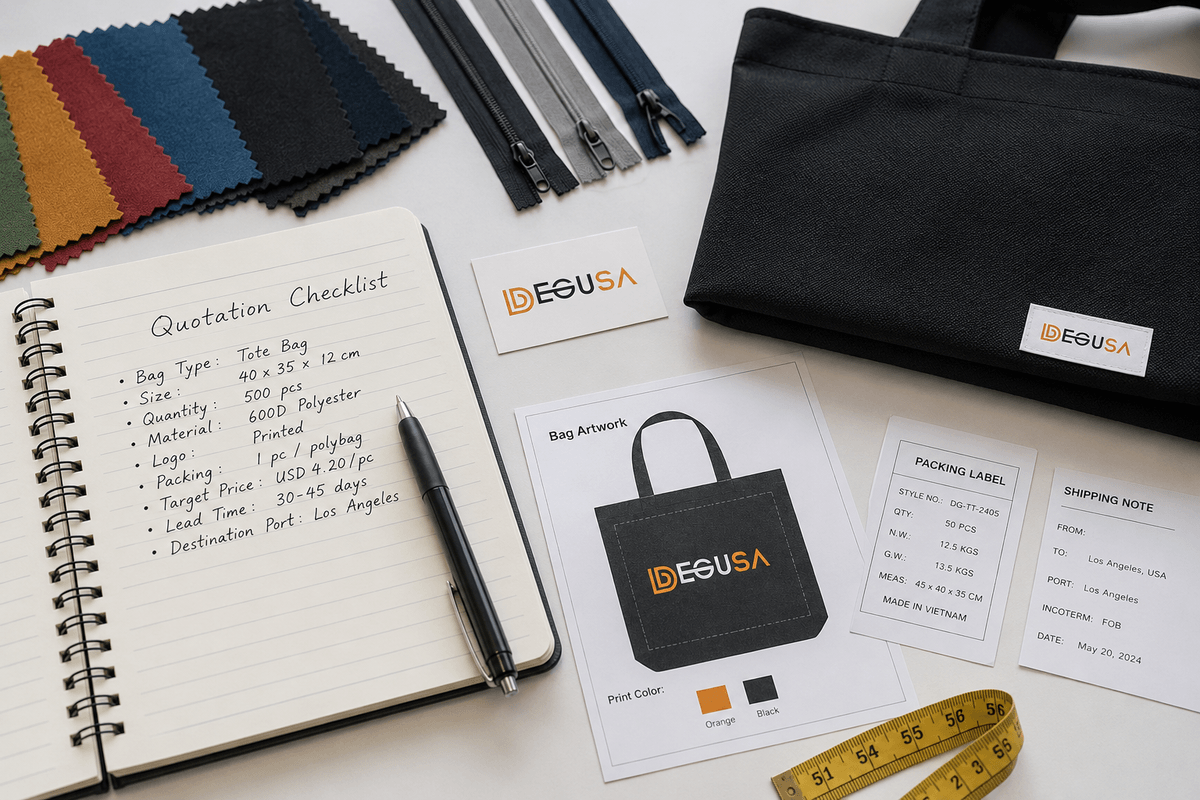
Before asking for a custom bag quotation, buyers should prepare the bag type, size, estimated quantity, material preference, logo artwork, logo method, color requirement, packing method, target price, target delivery date, destination port and any special function requirements.
The more complete the information is, the easier it is for the supplier to provide a realistic quotation, suggest suitable materials, estimate sample cost, and explain MOQ, production lead time and shipping options.
1. Bag Type and Target Use
The first thing buyers should prepare is the bag type. Different bag types have different materials, structures, workmanship requirements and cost levels.
For example, a backpack is different from a cooler bag. A sports bag is different from a cosmetic bag. A pet travel bag is different from a simple drawstring bag. Even if two bags look similar in size, their materials, lining, zipper, padding, stitching and structure may be different.
Buyers should tell the supplier what type of bag they want to make and how the bag will be used. A professional custom bag manufacturer in China can better suggest suitable materials, structure and workmanship when the target use is clearly explained.
Useful information may include:
- Backpack, cooler bag, sports bag, duffel bag, pet travel bag, racket bag, cosmetic bag or other style
- Daily use, promotional use, retail use, sports use, travel use or product packaging use
- Target customer group
- Main function of the bag
- Any special use condition, such as outdoor use, cold storage, pet carrying or heavy loading
This helps the supplier understand not only what the bag looks like, but also how it should perform.
2. Size and Structure Details
Size is one of the most important details for a custom bag quotation. Without size information, it is difficult to estimate material usage, cutting cost, sewing time and packing volume.
Buyers should provide the bag’s length, width and height. If possible, they should also provide pocket size, handle length, shoulder strap length, gusset width, bottom size and opening size.
If the bag needs to hold a specific product, the buyer should provide the product size as well. This is common for tool bags, racket bags, cooler bags, product sample bags, equipment bags and packaging bags.
If the buyer does not have exact dimensions, reference photos with approximate size can still help the supplier make an initial estimate. However, the final price may need to be adjusted after the sample development process.
3. Estimated Quantity
Quantity has a direct impact on price. A quotation for 300 pieces may be different from a quotation for 1,000 pieces or 5,000 pieces. This is because material purchasing, logo setup, production arrangement, labor efficiency and packing cost all change with quantity.
Buyers should provide an estimated order quantity when asking for a custom bag quotation. If they are not sure, they can ask for price options based on different quantities.
For example:
- 300 pieces
- 500 pieces
- 1,000 pieces
- 3,000 pieces
This helps the supplier show how price changes at different order levels. It also helps buyers understand MOQ and decide whether the project is suitable for a small test order or a larger production run.
4. Material Preference
Material is one of the biggest cost factors in a custom bag quotation. Different fabrics can create very different prices, even for the same bag style.
Buyers should tell the supplier what material they prefer, or share reference photos if they are not sure about the material name.
Material details may include:
- Polyester, nylon, canvas, RPET fabric or PVC material
- Waterproof or water-resistant requirement
- Fabric thickness or weight
- Lining material
- Foam, padding or insulation
- Mesh material
- Webbing quality
- Surface texture or coating
If the buyer wants a specific fabric, it is helpful to provide a material sample or clear reference. If the buyer is flexible, the supplier can suggest practical material options based on the bag’s function and target price.
5. Logo Artwork and Logo Method
Logo details should be prepared before quotation because different logo methods have different costs and production requirements.
Common logo methods include silkscreen printing, embroidery, woven label, rubber patch, leather patch, heat transfer, metal logo and custom zipper puller logo.
Buyers should provide clear logo artwork, preferably in AI, PDF, EPS or high-resolution format. They should also tell the supplier where the logo should be placed and how large it should be.
Logo details may include:
- Logo artwork
- Logo size
- Logo position
- Logo color or Pantone number
- Preferred logo method
- Whether the logo needs to be printed, embroidered, patched or molded
- Whether there are brand guidelines
If the logo method is not confirmed, the supplier can suggest suitable options based on the material, order quantity, target price and final appearance.
6. Color Requirement
Color also affects quotation, especially when the buyer needs a custom color. Standard fabric colors are usually easier to arrange, while custom-dyed fabric may increase MOQ, cost and lead time.
Buyers should provide color information as clearly as possible. Pantone numbers are helpful when color accuracy is important. If the buyer is open to available colors, they can tell the supplier that stock colors are acceptable.
Useful color information includes:
- Main fabric color
- Lining color
- Webbing color
- Zipper color
- Logo color
- Hardware color
- Pantone reference if needed
Clear color information helps avoid confusion during sampling and bulk production.
7. Packing Requirements
Packing is often discussed late, but it can affect the quotation. For export orders, packing is not only about protecting the product. It also affects carton size, carton weight, warehouse receiving, barcode labels and shipping documents.
Buyers should tell the supplier whether they need simple export packing or special retail packing.
Packing requirements may include:
- Individual polybag
- Hangtag
- Product label
- Warning label
- Barcode label
- Inner carton
- Master carton
- Quantity per carton
- Carton mark requirement
- Pallet requirement
- Retail packaging
If packing is customized, the packing supplier may have MOQ or setup cost. This should be considered before confirming the final price.
8. Target Price or Budget Range
Some buyers do not want to share target price, but a realistic budget range can help the supplier recommend suitable materials and production methods.
For example, if the buyer wants a premium retail bag, the supplier may suggest better fabric, stronger hardware and more detailed workmanship. If the buyer needs a promotional bag with a strict budget, the supplier may suggest simpler materials, standard colors and a more cost-effective logo method.
A target price does not mean the supplier can always meet it. But it helps both sides understand whether the project direction is realistic.
If the buyer has no target price, they can still explain whether the project is for budget promotion, mid-range retail, premium brand use or functional industrial use.
9. Target Delivery Date
Lead time is also important for quotation. A normal production schedule may be different from an urgent order. If the buyer has a fixed launch date, event date, promotion date or shipment deadline, it should be shared early.
A custom bag project may include several steps:
- Requirement review
- Quotation
- Sample development
- Sample revision
- Bulk material preparation
- Logo production
- Sewing production
- Quality inspection
- Packing
- Shipment
If the schedule is tight, the supplier needs to check whether sampling, material sourcing and production can be arranged in time.
10. Destination Port and Shipping Terms
The destination port or delivery location is important if the buyer wants a quotation including freight. A product price without shipping is different from a CIF, DDP or door-to-door quotation.
Buyers should tell the supplier where the goods need to be shipped. This may include the destination port, airport, warehouse address or country.
- Useful shipping information includes:
- Destination country
- Destination port
- Delivery address if door-to-door service is needed
- Preferred shipping method
- Sea freight, air freight or express courier
- Incoterms if already decided
If the buyer only needs an EXW or FOB quotation, they can also tell the supplier clearly. This helps avoid confusion when comparing prices from different suppliers.
11. Reference Photos, Samples or Tech Pack
Reference materials are very helpful for custom bag quotation. A photo can quickly show the bag shape, structure, pocket design, zipper position, handle style and overall feeling.
If the buyer has a physical sample, tech pack, drawing or previous product, it is even better. These references help the supplier understand the project more accurately.
However, buyers should also explain what needs to be changed. If a reference photo is only for inspiration, the supplier should know that. If the buyer wants the exact same structure with logo changes, that should also be clearly stated.
The clearer the reference, the more realistic the quotation will be.
12. Why Complete Information Helps Buyers Get a Better Quotation
A good custom bag quotation is not only a price. It should also reflect material choice, logo method, MOQ, sample cost, sample lead time, bulk production lead time, packing method and shipping terms.
When buyers provide complete information, suppliers can give a more useful quotation instead of a rough estimate.
Complete information can help buyers:
- Reduce back-and-forth questions
- Receive a more accurate price
- Compare suppliers more fairly
- Understand MOQ more clearly
- Avoid wrong material assumptions
- Plan sampling and production earlier
- Reduce changes after quotation
For overseas buyers, a clear quotation request makes the project easier to control from the beginning.
Simple Custom Bag Quotation Checklist
Before sending a quotation request, buyers can prepare this simple checklist:
- Bag type
- Target use
- Size
- Quantity
- Material preference
- Color requirement
- Logo artwork
- Logo method
- Packing requirement
- Target price or budget range
- Target delivery date
- Destination port or delivery location
- Reference photos, sample or tech pack
- Special function requirements
This checklist does not need to be perfect. Even if some details are not confirmed yet, sharing what is already known can help the supplier ask the right questions and give more practical suggestions.
FAQ
What information is needed for a custom bag quotation?
Buyers should prepare bag type, size, quantity, material preference, logo artwork, logo method, color requirement, packing details, target delivery date and destination port.
Can I ask for a quotation without a tech pack?
Yes. Buyers can still ask for an initial quotation with reference photos, size, material preference, logo requirement, quantity and target use. A tech pack helps, but it is not always required at the beginning.
Why does the supplier ask so many questions before quoting?
A custom bag price depends on many details. The supplier needs to understand material, size, structure, logo, quantity, packing and delivery requirements before giving a realistic quotation.
Should I provide a target price?
A target price is helpful if it is realistic. It helps the supplier suggest suitable materials, logo methods and production options based on the buyer’s budget.
Does quantity affect the quotation?
Yes. Quantity affects material purchasing, logo setup, production efficiency, packing cost and unit price. This is why suppliers often quote different prices for different quantities.
Conclusion
Before asking for a custom bag quotation, overseas buyers should prepare key information such as bag type, size, quantity, material, logo, color, packing, target price, lead time and destination port.
A clearer quotation request helps the supplier provide a more realistic price and helps the buyer compare options more fairly.
For custom bag projects, good communication starts before the quotation. When both sides understand the product details clearly, sampling, production and shipment can move more smoothly.
If you are preparing a new custom bag project, you can contact us to discuss your requirements and get practical suggestions before sampling or bulk production.
Author Note
This article was prepared by Angel from Degusa Bags Team, based on our daily work in custom bag quotation, sample development, material checking, logo confirmation, production coordination, packing review and export communication for overseas buyers.
Degusa Bags supports OEM and ODM custom bag projects, including backpacks, cooler bags, sports bags, duffel bags, pet travel bags, racket bags, cosmetic bags and other functional sewn products.